Blog
How Processing Shapes Coffee Flavor: What 12,500 Specialty Coffees Reveal
Processing is how the fruit is removed from the coffee bean after harvest, and it is one of the strongest influences on flavor, alongside variety, origin, altitude, and roast. To show how much it matters, we analyzed the processing method and tasting notes of more than 12,500 specialty coffees, then measured which flavors track with each method. This is the data companion to our guide on washed vs natural coffee, which walks through how each method works step by step.
How We Analyzed the Data
The flavors below come from the tasting notes printed on real specialty coffees, so they reflect what roasters taste in the cup rather than lab readings.
- We looked at the active coffees in Beanie's catalog that list a processing method: 12,553 coffees. About half the catalog lists no process at all, so we left those out.
- These counts come from a full snapshot of the catalog taken for this analysis. The live browse and category pages may show smaller numbers, because they reflect what is currently visible and filterable on the site rather than the whole snapshot.
- We grouped similar wordings together and counted each note once per coffee, so a single bag cannot inflate a pattern.
- For each process we counted only notes that appear at least 15 times, to reduce noise. A high multiplier built on a handful of coffees can swing hard, so we show the underlying count next to the bolder claims.
For every note we compared how often it shows up in one process versus across all coffees that list tasting notes. That ratio is the "how much more common than average" figure:
How much more common than average = (share of a process's coffees that list the note) ÷ (share of all coffees that list the note)
A figure of 3.8x means strawberry shows up almost four times as often in natural coffees as in the catalog overall.
One caveat to keep in mind throughout. Processing methods are not spread evenly across origins and varieties: anaerobic coffees lean toward experimental producers, naturals lean toward Ethiopia and Brazil, and honey processing clusters in certain regions. So these patterns show association rather than proof that processing alone causes the flavor differences. Origin, variety, and roast are tangled up in the numbers too.
A note on limitations: tasting notes are written by roasters rather than measured in a laboratory, and different roasters may describe similar flavors differently. The analysis reflects patterns in specialty coffee sensory descriptions, not direct chemical measurements.
The Four Main Processing Methods
In the Beanie catalog, four methods account for almost all of the coffees that list a process. Here is how common each one is among them:
Share of the 12,553 labeled coffees
| Process | Share of labeled coffees | Coffees | What it is |
|---|---|---|---|
| Washed | 54.0% | 6,780 | Fruit removed before drying |
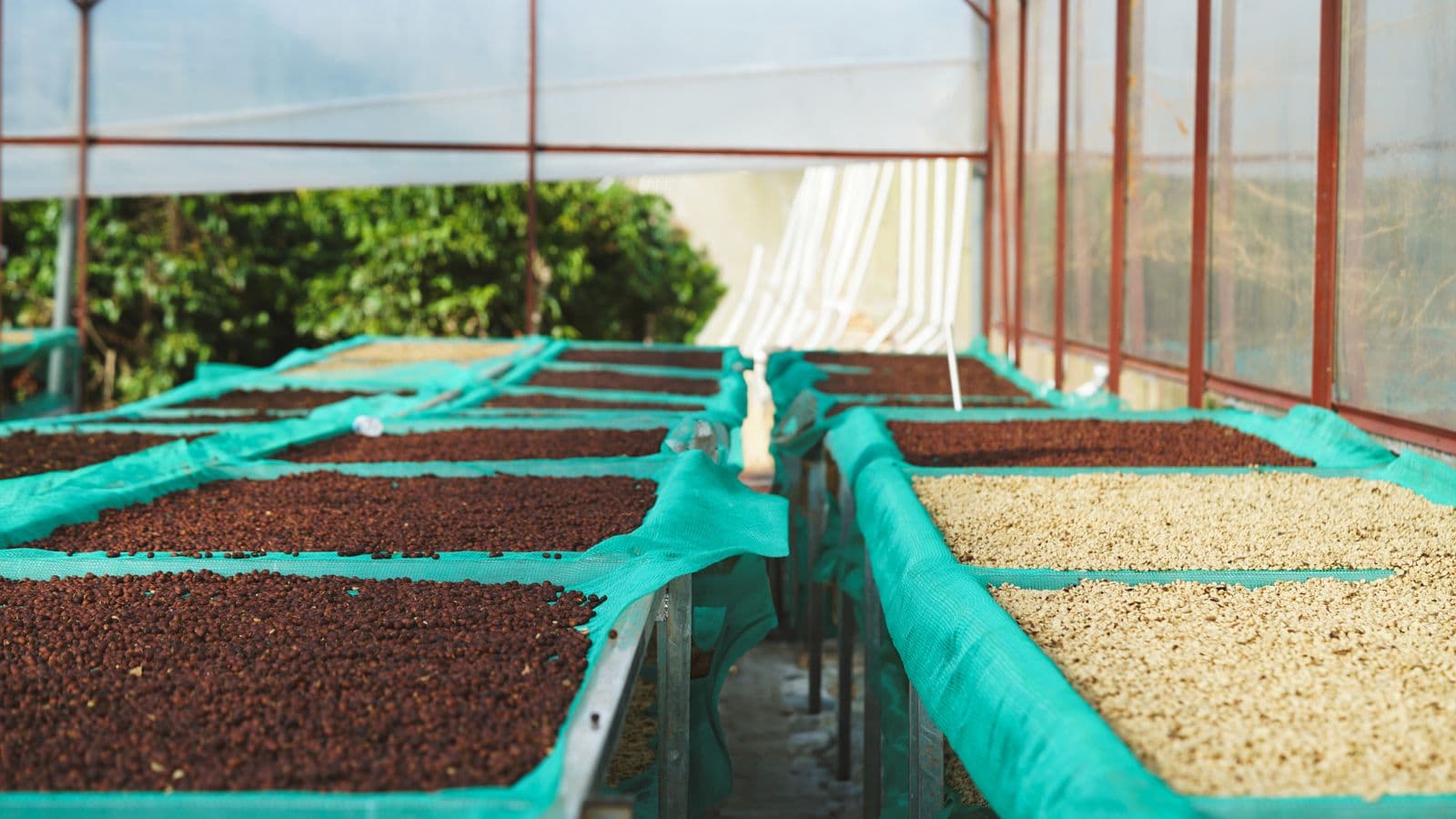
| Natural | 22.6% | 2,833 | Bean dried inside the whole fruit |
| Honey | 6.6% | 833 | Some fruit left on during drying |
| Anaerobic | 6.2% | 783 | Fermented in sealed, oxygen-limited containers |
A fifth method, water-process decaf, accounts for 4.6% (574 coffees), but that describes how caffeine was removed rather than how the fruit was handled.
The headline finding: washed coffee is the default, used in more than half of all labeled coffees, and the other three methods are where bold processing-driven flavors become much more common.
What Each Process Tastes Like
Washed: The Clean Baseline
Washed coffee is the most common method and had the weakest process-specific flavor signature in our data. No single flavor is strongly tied to it. The most over-represented notes barely reach 2.3x, compared with 7.2x for the boldest anaerobic note. That measures how strong a process signature is, and says nothing about how interesting or complex the cup is: a washed Kenyan or Ethiopian can be wildly distinctive on the strength of its origin alone.
That is the point of washed processing. Removing the fruit early lets the bean and the growing region come through, so the cup tastes clean and clear rather than dominated by fermentation. When a flavor does lean washed, it tends to be a subtle, bright one:
- Top washed notes
- White tea 2.3x, pink grapefruit 2.1x, clementine 2.0x, key lime 2.0x
- Character
- Clean, bright, delicate citrus and floral
- Body
- Light to medium
If you want to taste where a coffee is from, washed is the method that gets out of the way.
Natural: Berry and Jam
Natural coffees dry with the fruit still on the bean, and weeks of contact leave a heavy, fruity imprint. Berries dominate the signature, and several jammy, winey notes cluster right behind them:
- Strawberry
- 3.8x more common (9.8% of naturals, n=263)
- Blueberry
- 3.4x more common (6.5% of naturals, n=176)
- Also distinctive
- Purple grape 4.7x, blueberry jam 4.3x, concord grape 3.7x, strawberry jam 3.7x, winey 3.6x, jammy 3.5x
Strawberry and blueberry are not just over-represented, they are common in absolute terms too, showing up in roughly one in ten naturals. If a coffee tastes strongly of berries and jam, natural processing is often part of the reason.
- Character
- Bold, sweet, fruit-forward
- Body
- Medium to full
Honey: Soft Stone Fruit
Honey processing sits between washed and natural. Some of the sticky mucilage remains on the bean during drying, which is associated with sweeter, fruitier cups than washed coffees, without the full intensity of a natural. Its signature is gentler and leans toward stone fruit:
- Honey
- 2.5x more common (10.8% of honey coffees, n=86)
- Nectarine
- 2.7x more common (4.0%, n=32)
- Also distinctive
- Papaya 2.8x, red grape 2.6x, apricot 1.9x
Interestingly, "honey" also turns up as a common note in honey-processed coffees, though the process name itself comes from the sticky, honey-like mucilage left on the bean rather than from any guaranteed taste of honey. The rest of the profile reads as soft, ripe orchard fruit.
- Character
- Sweet, rounded, stone fruit
- Body
- Medium
Anaerobic: Tropical and Wild
Anaerobic processing ferments the coffee in sealed, oxygen-limited environments, usually tanks or barrels. Coffees labeled anaerobic showed the strongest concentration of distinctive tropical and fermentation-associated notes in our dataset, with the highest lift numbers we measured:
- Passion fruit
- 7.2x more common (2.3% of anaerobics, n=17)
- Watermelon
- 5.6x more common (3.2%, n=24)
- Mango
- 5.4x more common (6.9%, n=52)
- Lychee
- 5.4x more common (4.0%, n=30)
- Also distinctive
- Papaya 4.7x (3.3%, n=25), guava 4.4x (2.7%, n=20), pineapple 4.1x (5.3%, n=40)
No other process comes close to these multipliers. The catch is that the anaerobic pool is small, so the boldest lifts rest on modest counts: the 7.2x passion fruit figure comes from 17 coffees, not hundreds. Read the multipliers as a strong directional signal rather than a precise measurement. If a coffee tastes intensely tropical, almost like a fruit punch or a fermented funk, anaerobic processing is often part of the story.
- Character
- Intense, tropical, funky
- Body
- Varies, often syrupy
Signature Flavors at a Glance
Each method's strongest flavor pull
| Process | Signature notes | How much more common |
|---|---|---|
| Washed | White tea, pink grapefruit, clementine | Up to 2.3x |
| Natural | Strawberry, blueberry, jammy, winey | 3.4x to 4.7x |
| Honey | Honey, nectarine, apricot, papaya | 1.9x to 2.8x |
| Anaerobic | Passion fruit, watermelon, mango, lychee | 4.1x to 7.2x |
Two things to keep in mind. The notes come from people tasting coffee, so they are descriptive and vary between tasters. And these are general tendencies: any single coffee can taste different depending on its origin, variety, and roast.
How to Use This When Choosing Beans
Processing is a fast shortcut to the kind of cup you will get:
- Want to taste the origin? Choose washed. It is the clean, neutral baseline, and it lets the growing region and variety come through.
- Want bold fruit and sweetness? Choose natural. Expect berries, jam, and a heavier body.
- Want sweetness without the intensity? Choose honey. It is the gentle middle ground, leaning on stone fruit.
- Want something wild and tropical? Choose anaerobic. It is the most adventurous and the most polarizing.
A coffee discovery tool that lets you filter by process and tasting notes makes this easy: once you know whether you lean clean or fruity, you can look for the method that delivers it.
Common Mistakes
- Assuming the bag always says. About half the specialty coffees we looked at list no process at all. If it matters to you, check the roaster's product page or ask.
- Treating washed as boring. Clean is a feature. Washed coffees show off origin and acidity better than any other method.
- Expecting every natural to taste the same. Natural is the broadest category after washed, and its fruit can range from delicate berry to heavy, winey, almost boozy.
- Buying anaerobic as a first specialty coffee. The flavors are intense and unusual. They are exciting once you know what you like, but they are not the gentlest starting point.
Frequently Asked Questions
What is coffee processing?
Coffee processing is the method used to remove the fruit from the coffee bean after harvest. How long the bean stays in contact with the fruit, and how it dries, has a major effect on the final flavor.
Which processing method has the most flavor?
Coffees labeled anaerobic carried the most distinctive flavors in our data, with notes like passion fruit appearing more than seven times as often as average. Washed coffees had the weakest process signature, which is part of why the bean's origin is easier to taste.
Why does natural coffee taste fruity?
Natural coffees dry with the whole fruit surrounding the seed, which creates conditions often associated with sweeter, fruitier flavor profiles. In our data, strawberry and blueberry each appear in roughly one in ten natural coffees.
What is honey processed coffee?
Honey processing leaves some of the sticky mucilage on the bean during drying. It is a middle ground between washed and natural, associated with sweeter cups and soft stone fruit notes like nectarine and apricot, without the full intensity of a natural.
How can I tell what process my coffee used?
Specialty roasters usually list the process on the bag or product page, near the origin and variety. Look for words like washed, natural, honey, or anaerobic. If it is not listed, it is fine to ask the roaster directly.
Is one processing method better than the others?
No. Each method produces a different style of cup. Washed is clean and origin-driven, natural is bold and fruity, honey is sweet and rounded, and anaerobic is intense and tropical. The best one depends on what you enjoy.
From the Beanie catalog
Washed coffees to explore



Bolivia APROCAFE
Bolivia · Washed
No longer listed on the roaster's website